
Content on this page requires a newer version of Adobe Flash Player.

Get Adobe Flash player

more afterschool video
Policy & Action Center

Take action now to support afterschool programs as part of the Appropriations process.

Learn more about ESEA, Child Nutrition and other afterschool policy issues.

Call on your Senators to Cosponsor the AFTERschool Meal Act of 2009.

Learn about resources for afterschool through the American Recovery and Reinvestment Act.

Send a Message to Congress on Today's Pressing Afterschool Issues

Vol. 11 Issue 6 (05/27/2010)
Top Stories
Just One in Four Kids in U.S. Attend Summer Learning Programs
Mayors Speak Out on 21st CCLC
Cosgrove Performs For Afterschool

Outreach
Funding
In Their Own Words...
In The News
Resources
Quick Takes
Calendar

Just One in Four Kids in U.S. Attend Summer Learning Programs
For millions of children in America, when schools close for the summer, safe and enriching learning environments are out of reach, replaced by boredom, lost opportunities and risk. New analysis of data from the America After 3PM study measures the extent of this problem, concluding that three-quarters of America's schoolchildren do not participate in summer learning programs - safe, structured programs that provide a variety of activities designed to encourage learning and development in the summer months. Yet, 56 percent of kids (an estimated 24 million) who are not participating in summer learning programs would likely enroll in a program, based on parent interest.

America After 3PM is a survey of nearly 30,000 households across the United States, commissioned by the Afterschool Alliance and JCPenney Afterschool in 2009. The summer learning report, released this week, is sponsored by The Wallace Foundation. It finds that 43 percent of the estimated 14.3 million children who attend summer learning programs qualify for free or reduced price lunches. But the unmet demand also is great for low-income children, many of whom are unsupervised during the summer months. Nearly half of kids whose parents say they are interested in enrolling them in summer learning programs (46 percent) qualify for free or reduced price lunches.

"These findings are sobering, especially because we know that inequities in summer learning are a major contributor to the achievement gap between high- and low-income students," said Afterschool Alliance Executive Director Jodi Grant. "When we leave children unsupervised during the summer, we miss critical opportunities to improve their academic achievement and we take away crucial supports like nutritious meals and snacks. By not creating and funding enough summer learning programs, we are missing the chance to engage and educate millions of students during the summer, and instead are leaving them unsupervised and at risk."

Grant urged lawmakers to fund 21st Century Community Learning Centers, which support afterschool and summer programs. Other findings from the new study:

* Thirty-five percent of African-American, 29 percent of Hispanic and 27 percent of low-income children attended summer learning programs in 2008, compared to the national average of 25 percent.
* Yet more than three in four African-American kids (77 percent) and at least two in three Hispanic (70 percent) and low-income (67 percent) kids would likely enroll in a summer learning program, based on parent interest.
* Eight in ten parents (83 percent) support public funding for summer learning programs.
* Fully 95 percent of African-American, 91 percent of Hispanic and 90 percent of low-income parents support public funding for summer learning programs.

"If we are to overcome the achievement gap, we must find ways to increase opportunities for high-quality summer learning and encourage more children to participate in them," said Nancy Devine, director of communities at The Wallace Foundation.

"The long summer break is a precarious time when many low-income children fall behind academically and lose the nutritious meals, supervision, and structure that school provides," said Ron Fairchild, chief executive officer of the National Summer Learning Association (NSLA). "This survey shows just how great the demand is for meaningful summer activities and that too many children are left wanting for quality programs - the very children who could benefit most if given the opportunity. Policymakers and educators who are cutting summer programs should pay attention to these findings."

NSLA is leading a new national initiative called A New Vision for Summer School, which seeks to replace remedial summer school with comprehensive and engaging programs. It also is sponsoring Summer Learning Day 2010 on June 21; please visit the NSLA website for tools to plan activities, including a news release template that includes this new data. On June 15, NSLA will host a briefing to explore a "New Vision for Summer School" in Washington, D.C. It will feature pioneering summer learning programs, and provide recommendations on how federal policy can help make summer programs an essential component of education reform.

The new America After 3PM Special Report on Summer report provides data on the percent of children who participate in summer learning programs in each state, as well as the percent of children who do not participate but whose parents are interested in enrolling them. It also measures support for public funding of summer learning programs in each state.

America After 3PM Special Report on Summer is sponsored by The Wallace Foundation. All data cited in the report are from the 2009 America After 3PM research, which was sponsored by JCPenney Afterschool.

Between March and May 2009, 29,754 parents/guardians responded to survey questions about their after school and summer child care arrangements during the summer of 2008 and the 2008-2009 school year. RTi, a market research firm, conducted the survey and analyzed the data for the Afterschool Alliance. According to U. S. Census data from 2007, the total school-age population is 57.3 million, which is the foundation for the national projections in America After 3PM Special Report on Summer.

The new report and state data are available online at www.afterschoolalliance.org.

+ return to top

Mayors Speak Out on 21st CCLC
From Maui to Los Angeles to Louisville to Little Rock and beyond, more than 40 mayors from across the country sent a letter to the U.S. Senate on May 11th pressing for increased support for before-school, afterschool and summer learning programs. The letter was addressed to Senators Tom Harkin (D-IA) and Michael Enzi (R-WY), chairman and ranking member of the Senate Health, Education, Labor and Pensions Committee.

"We urge you to continue and expand the Committee's strong bi-partisan support for before-school, afterschool and summer learning programs through 21st Century Community Learning Centers (21st CCLC)," the letter says. "As mayors working in cities all over the nation, we understand how critical this program is to providing support for more than 1 million children in all 50 states and the District of Columbia. A wealth of research and data demonstrates that these programs help children academically, socially and behaviorally."

"Communities like ours rely on 21st CCLC as an essential source of afterschool program funding that leverages a wide array of funding - local, state and private - as well as partners, including faith-based organizations, nonprofits, businesses, educational organizations and volunteers... Now is the time to expand access for more of our most at-risk students, not divert much needed afterschool funding to create new programs that will result in even more children home alone," it continues, referring to the President's Blueprint for education reform, which would divert funds from afterschool programs to efforts to extend the school day. For more information on the Blueprint for Reform, click here.

In the letter, the mayors ask Committee members to "protect and expand afterschool programming," as well as oppose cuts to 21st CCLC. It was sent on behalf of the U.S. Conference of Mayors, and was spearheaded by Providence, Rhode Island Mayor and Afterschool Alliance Board Member David Cicilline.

+ return to top

Cosgrove Performs For Afterschool
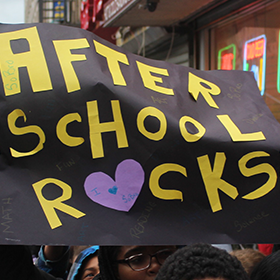
Sparks were flying last week when 300 youth were treated to a live performance by Nickelodeon superstar and afterschool supporter Miranda Cosgrove. Cosgrove performed songs from her newly released debut album "Sparks Fly" to an invitation-only crowd in Plano, Texas. Suzy Herzog and her eight-year-old daughter, Maddy, won the performance for themselves and their friends through the Quaker Chewy and Afterschool Alliance contest, part of the Quaker Chewy Afterschool Rocks campaign.

"The Quaker Chewy Afterschool Rocks campaign is building support for quality afterschool programs that give children opportunities to learn and grow," said Bill Fiely, senior brand manager, Quaker Oats. "By partnering with the Afterschool Alliance and Miranda Cosgrove, Quaker Chewy is working to provide wholesome snacking afterschool and the benefits of afterschool programs to all children."

Cosgrove's new album debuted in Billboard's Top Album chart at #8, with a hit single "Kissin U" landing at Top 40 Radio. She is the star of Nickelodeon's highest rated live-action show, "iCarly," and winner at 2010 Nickelodeon Kids Choice Awards. She will also star in the animated film "Despicable Me" due in theaters this summer.

As the Official Snack of Afterschool, Quaker Chewy 90 Calorie Granola Bars have long been an afterschool snack both moms and kids love, providing half a serving of whole grain and no high fructose corn syrup. For more information on the Quaker Chewy Afterschool Rocks campaign or to learn more about the importance of afterschool programs, please visit www.QuakerOats.com.

+ return to top

How to Become an Advocate and Media Superstar for Afterschool
CEO of the YMCA of the Northwoods in Rhinelander, Wisconsin, Chris Francis did a lot for afterschool in just one week. He flew to Washington, D.C., testified before Congress, and generated a media blitz in his hometown, all focused on the need for more afterschool funding. How did he do it?

Becoming an Advocate
"It was a great experience," said Francis, an Afterschool Ambassador for the Afterschool Alliance, about testifying before the House Appropriations Subcommittee on Labor, Health and Human Services, Education, and Related Agencies. "I feel like a lot was accomplished in that short four minutes [the time allotted for each witness' testimony]. Others need to do as much as they can to get the afterschool message out."

In testimony before the powerful Appropriations Subcommittee, Francis discussed the academic benefits of afterschool. His programs are closely aligned with the school day, and staff members keep close tabs on each child's development. More than 100 students regularly attend both of Francis' YMCA programs. He emphasized how many more children his program would be able to serve if federal funding for afterschool were increased.

Speaking to legislators and policy makers matters a great deal, Francis said. "It matters that they remember you when they go to make important decisions affecting your community. And they remember you when they get to tour your program and meet your kids."

Reaching the Media
Reporters "started calling me within 30 seconds of the press release going out," Francis said of his media blitz. "The radio called right away. The TV came out and ran three different stories on our program, and one was the lead story." Francis was also featured in the local newspaper.

He credits the quick response with the relationships he has built over the years. His involvement with other civic organizations puts him in regular contact with a news director at a local television station, as well as the station manager. "It only takes having one contact with the station. They're always looking for news stories, and this one was a big deal for our town" Francis said.

Testifying before Congress is not the only way to reach media, according to Francis. Strong evaluation data about a program's impact, and a local afterschool event can sometimes be enough. Francis' organization has a media office with the ability to create press releases, but he recommends the Afterschool Alliance's media toolkit for those who do not. "If writing press releases isn't your specialty, start with the resources from the Afterschool Alliance. The press kits can really help you get started," he said.

+ return to top

Afterschool For All
You can help make afterschool for all a priority in your community and in communities nationwide by joining the Afterschool for All campaign. Already more than 25,000 concerned individuals and organizations have signed on to the campaign in support of afterschool programs and the families they serve. It takes only a minute to add your name to the national list of partners. Sign up today.

Visit the Afterschool for All website to see which new partners have signed up in your state. Contact Marie Coichy-Dauphin, Project Manager, Afterschool for All at mdauphin@afterschoolalliance.org or at 646-943-8662 with any questions or comments.

+ return to top

Funding News
The Afterschool Alliance's website has resources for afterschool providers, including tips for initiating relationships with funders and businesses, and for identifying funding opportunities. To learn more, click here. Remember to check here to find out how afterschool programs may be able to tap into economic recovery funds.

GRANTS/AWARDS AVAILABLE

Local Hero Award
Bank of America's Neighborhood Excellence Initiative honors outstanding individuals who are shaping the communities in which they live through the Local Heroes award. Each Local Hero is able to direct a $5,000 grant donation from the Bank of America Charitable Foundation to an eligible nonprofit of their choice, and is recognized at a public ceremony celebrating their achievements. The application deadline is June 1. For more information, and to apply, click here.

+ return to top

Voices from the Afterschool Storybook...
"DOIT [Disabilities, Opportunities, Internet-working and Technology Program ] has helped me achieve things I would have never gotten the chance to experience without it. They helped me get internships with Amazon.com and later with the Federal Aviation Administration, where I now work. DOIT's mission is to help people with disabilities succeed in life and fulfill their dreams, no matter how big those dreams are! Today, in addition to working full time for the Federal Aviation Administrator as an Office Administrator, I serve as an ambassador for the DOIT Program."
-- Marissa Griffin, Des Moines, Washington

To read Griffin's story, and read more afterschool voices from across the country, click here. Share your story here.

+ return to top

Arizona
In a drastic budget cutting move, the city of Phoenix has closed dozens of afterschool programs and increased fees at the remaining sites. Mostly recently, the families of 519 children were notified that the Parks and Recreation Department's Phoenix Afterschool Center program would be ending. At the city's remaining afterschool programs, parents will pay up to $720 in yearly fees, the Arizona Republic reports - an increase of as much as 400 percent from last year.

+ return to top

California
San Francisco Mayor Gavin Newsom announced that, in spite of eliminating summer school because of budget cuts, the city's summer camp programs will be able to accept almost three times as many students this year. Fees have also been eliminated for students living in public housing. The Recreation and Park Department is expanding slots in its 57 summer camps from 9,800 to 28,000 openings, the San Francisco Chronicle reports. "That's a big deal," Newsom said. "This is... rather extraordinary considering the limitation of resources."

+ return to top

Maryland
Twelve years ago, a group of sixth-graders at The Stadium School in Baltimore had a dream, and signed a pledge to open an afterschool program in their inner-city neighborhood. Now, after years of fundraising, writing grant proposals, launching a non-profit, buying a home, appealing zoning rules and remodeling, "The Youth Dreamers" have finally seen their youth center - The Dream House - open. They also took time over the years to get to know the neighbors around the new center, the Baltimore Sun reports, delivering Christmas wreaths and other presents or picking up trash to ease fears that the center would become a hangout for rowdy teenagers. "It definitely took patience and willingness to fail," Chekana Reid, now 21 years old, said. "We never gave up." To learn more about The Youth Dreamers and The Dream House, click here.

+ return to top

New Hampshire
If the power goes out again in Dover - like it did during the December 2008 ice storm - children will be well prepared to make it through, thanks to the afterschool program at Woodman Park Elementary School. As part of their service project, the third- and fourth-graders made 20 emergency power outage kits, each of which includes a flashlight, candles, matches, glow sticks, gloves, candy and a deck of cards. The kits were donated to a local homeless shelter and to the Dover Chamber of Commerce, which will give them to families that have recently moved to the area, Foster's Daily Democrat reports.

+ return to top

New Jersey
"This is a club activity that is just out of this world," Carl Sandburg Middle School Principal Kenneth Popovich told the Courier News - and he means that quite literally. NASA astronauts aboard the International Space Station will perform an experiment designed by The Sandburg Scientists, the school's afterschool science club, after their proposal won first prize in the Kids in Micro-g challenge. The club's experiment involves testing slingshots in zero gravity to see how fast and far a projectile will travel in comparison to the results they recorded in their Old Bridge classroom.

+ return to top

Vermont
Mount Anthony Union Middle School students are slowly taking over downtown Bennington businesses, learning what they do and how they operate, and sometimes lending a hand. They're part of the "Downtown" afterschool program, run by the Southwest Vermont Supervisory Union, which aims to connect kids to the communities in which they live, and inspire them to go into business in the future. "The kids are a big part of the community, and I think we need to embrace them more and have them be a part of downtown," program director Robert Marine said. Students have already printed their own t-shirts at a sports store, made desserts at a bakery and pizza at a restaurant, and visited a family-owned brewery, the Bennington Banner reports.

+ return to top

Wyoming
A six-week afterschool program offered by the Campbell County Memorial Hospital's functional health department is teaching Gillette students and parents the basics of nutrition and healthy eating. The Individuals Combining Activity and Nutrition (ICAN) program educates children about vitamins, portion sizes, meal planning and preparation, and reading food labels. Parents are also encouraged to join the program with their students, to observe and learn. Each health lesson is followed by a physical activity, like an obstacle course, the Associated Press reports.

+ return to top

Resources
Reaching Older Youth
The Harvard Family Research Project and Public/Private Ventures recently released a report, Engaging Older Youth. It examines successful strategies to promote afterschool among older youth and to sustain participation from this age group. The report studies the practices and structural features of nearly 200 programs in six cities that primarily serve low-income youth. The findings show that youth leadership opportunities and staff involvement with youth beyond the scope of the program are highly effective strategies to keep older youth involved. The report was supported by The Wallace Foundation.

High School Afterschool
Temescal Associates has released a series of two brief videos, filmed by afterschool videographers, which demonstrate the power of afterschool for high school-age youth. The videos, Beyond Expectations, look at high school afterschool programs across California and feature the youth themselves discussing the elements of powerful programs that motivate them and enrich their lives. While the videos can serve as a tool for advocates to demonstrate the importance of afterschool for this difficult to reach group, they also highlight best practices for providers who are looking to enhance their high school-age programs. To view the videos, click here for Part 1, and here for Part 2.

+ return to top

Illinois Legislation Guarantees Access to Afterschool Program For All Kids
Pending the stroke of the governor's pen, universal access to afterschool programs will be state law in Illinois. The Illinois Afterschool Youth Development Program Act (SB 3543), which passed with overwhelming majorities in the state legislature, sets the stage to give every child in the state access to an afterschool program. It also creates a Youth Development Council, which will survey all state-funded afterschool programs and establish standards for best practices and program evaluation.

"It's the state coming out and saying: 'We know this is important,'" Kelley Pasatta, campaign manager for Afterschool for Children and Teens Now (ACT Now!) told the Chicago Tribune. ACT Now! and the Illinois After-school Alliance helped lead the effort to pass the legislation.

Supporters and legislators will now turn their attention to funding these programs, either from state sources or private donors. "I know that the state's budget is horrendous right now," Senator Toi Hutchinson (D-Olympia Fields), lead sponsor of the bill, said. "Dollars down all over the place, but I think we can do it."

+ return to top

Afterschool Profile: Rural Afterschool Kids Compete in National Robotics Competition
Built any robots lately? If you're a high school afterschool student from the rural town of Camdenton, Missouri, the answer might well be, "Yes!"

A team of 27 students from Camdenton's Project PASS (Partners Assisting in Student Success) spent much of the last several months designing and building a soccer-playing robot to compete against other robotics teams in a regional competition in March. After doing well there, they advanced to a national competition in April in the Georgia Dome, home of the Atlanta Falcons.

"This was just a great experience from beginning to end," said Sherry Comer, director of Project PASS and an Afterschool Ambassador. "It's the kind of thing our kids are going to remember with pride for the rest of their lives. And it's going to serve them well when they apply to college and enter the job market. I couldn't be prouder of what they've accomplished, and particularly because this was the first year we've participated in the competition. We never expected to do so well!"

The FIRST Robotics competition is the brainchild of inventor Dean Kamen, creator of the Segway, the one-person, two-wheeled, battery-powered transportation device - a sort of a stand-up scooter. Among inventors it is best known for its system of gyroscopic stabilization, so sensitive to riders' weight shifts that riders often say the device seems to read their minds. Many police departments have begun to use them in busy pedestrian areas, and fleets of Segways are often used by tour companies to help quickly bring tourists where buses cannot. Kamen created the competition as a way to encourage a new generation of innovators and engineers, which he says is "important as we try to build momentum in the United States to fuel a robust talent pipeline of innovative 21st century STEM [science, technology, engineering and math] professionals."

The Camdenton team attracted a series of grants that made its participation in the competitions possible. Awards from the JCPenney Afterschool Fund and the National 4-H Council got the program off the ground, and a grant from a special NASA program covered the team's entry fee for the regional competition as well as the cost of parts for their robot. After succeeding in the regional competition in St. Louis, the team needed more funding to go on to Atlanta. Comer and others began seeking that second wave of funding on the bus ride back from the regional competition, firing off emails, text messages and cell phone calls. More funders stepped up in response, and a few short weeks later, the team headed for Atlanta.

All of the competing teams began the competition with the same parts at their disposal - in this case a kit that included motors, batteries, a control system, a PC, and a mix of automation components. Significantly, the kit has no instructions, so it remained for students, working with adult mentors over a period of six weeks, to envision and build a robot that could kick a soccer ball. Competitions pit robots from six teams - three per side - against one another. For the first 15 seconds of each competition, the robots operate on a pre-programmed script, and for the remaining two minutes of the match, students operate the robots wirelessly, using joysticks.

Comer's husband, Mitch Comer, is the Project Lead the Way Engineering and Architecture teacher at Camdenton High School. He provided engineering expertise during the grant-writing stage, and then worked with the team as it created its robot.

"This was a terrific challenge for our kids, one that I bet very few adults could master," Comer says. "I'm lucky to be married to one of them! Mitch was a great resource for us, and local engineers from Speedline Technologies and Lake Professional Engineering served as technical advisors to the team, as well. But in the end, the design and the construction work was the kids', so they rightly feel a sense of ownership for what they've accomplished."

+ return to top

Going Global After School
A new Longview Foundation-Afterschool Alliance Issue Brief, "Afterschool and Global Competence: Expanding and Enhancing Learning Opportunities," explores how afterschool programs can facilitate global learning for youth. It was unveiled at the April 2010 Afterschool for All Challenge, in partnership with the Longview Foundation for Education in World Affairs and International Understanding.

The new Brief finds that afterschool programs provide an ideal platform for teaching the skills and cultural awareness that students need to live and work in a global 21st century. By partnering with existing cultural and heritage institutions in the community, afterschool programs can create more meaningful lessons than a traditional classroom. Students learn essential cross-culture communication skills, collaboration and civic participation, and often technological literacy.

"Afterschool programs are providing global learning opportunities to youth while helping them gain the global competencies that are critical to their success in college and beyond. As the skills needed to compete in the global workforce continue to evolve, so will the practices of afterschool programs... The future of the U.S. as a global leader depends on the ability of American workers to think critically, act strategically, and communicate effectively - skills that can be learned in afterschool programs that incorporate global learning," the Brief says.

The Issue Brief offers several examples of afterschool programs that have successfully implemented global learning, and suggested resources to help programs integrate international education into their programs. To view it, click here.

The Afterschool Alliance invites you to submit feedback on this Issue Brief. Please send comments to mdauphin@afterschoolalliance.org.

+ return to top

Keeping Fit Afterschool
Sony Pictures' "Get Your G.A.M.E. (Get Active, Move and Exercise) On" is a fun-filled fitness program designed to encourage kids to be active 60 minutes a day. Developed in partnership with the National Association for Sport and Physical Education (NASPE), "Get Your G.A.M.E. On" kicks off with an hour-long circuit training program designed for either ages 6-11 or 12-14 that any fitness instructor can easily teach in a gym, playground or playing field. All lesson plans and activities meet the NASPE National Standards for Physical Education. While the fitness program is tied to the upcoming movie The Karate Kid, there are no martial arts components to the fitness program.

The fitness and fun continue! All participants will receive take home materials that include a physical activity log and ideas on how to keep physically active. Starring Jaden Smith and Jackie Chan, The Karate Kid opens at movie theaters on June 11, 2010. For more information about the fitness program and to download the lesson plans and mini-posters, go to www.GetYourGame-On.org.

+ return to top

Attention Afterschool Scientists!
Afterschool programs across the country are invited to participate in the USA Science & Engineering Festival's Kavli Science Video Contest. Student teams are asked to create 90-second videos that show "why science is cool." Videos might explore a scientific concept, show the wonders of nature, provide a glimpse into the future, demonstrate what scientific discovery has done in the past or will do in the future, profile a great scientist or engineer, or simply show why others should care about science and engineering.

Videos can be linked to current curriculum, a science fair project, or whatever works best for students. Winners will receive cash prizes for their school or afterschool program, electronics prizes, and possibly even a trip to Washington D.C. to attend the USA Science & Engineering Festival Expo on the National Mall in October. The deadline for submissions is July 15. For more information, click here or contact Stacy Jannis at jannisprods@earthlink.net.

+ return to top

Rubik's Cube Tournament
Mathematicians and lovers of mysteries will want to take part in the USA Science & Engineering Festival Rubik's Cube Tournament. The program is looking for students who would like to learn how to solve the Rubik's Cube and compete against other teams for prizes and a chance to meet Professor Erno Rubik, creator of the Rubik's Cube.

The tournament is open to all public, private, religious, home schools, afterschool, and other non-profit community youth organizations in the Greater Washington DC area, including Delaware, Maryland, Virginia and West Virginia, serving grades K-12. The preliminary tournament will take place October 21 at the National Electronics Museum in Washington, D.C. The top six finalists will compete for the championship at the USA Science & Engineering Festival Expo on the National Mall on October 23. Prizes range from $100 to $1,000 and will be awarded to winning schools or afterschool programs. To learn more, click here.

+ return to top

Keep Up With Afterschool News!
Hungry for the latest news on afterschool? Be sure to check out Afterschool Snack, the Afterschool Alliance's up-to-the-minute blog on afterschool news, trends and information from across the country. Recent posts include:

* Congressman Kildee Makes the Case for Educating the Whole Child: Support Afterschool Programs
* Mayors Weigh-In on Afterschool and ESEA Reauthorization
* White House Release Obesity Prevention Report
* Witnesses at House Hearing Support Increased Funding for Afterschool

And be sure to tune in every Wednesday for a national news round-up, and throughout the week for your daily dose of afterschool. Check out Afterschool Snack here.

+ return to top

Mark Your Calendars...
* June 1, 2010
The National Girls Collaborative Project is sponsoring a free webinar based on the PBS television series SciGirls. The webinar will explore proven strategies and approaches to increase girls involvement in science, technology, engineering and math activities. For more information and to register, click here.

* June 7, 2010
The National Summer Learning Association is sponsoring the final in a series of six webinars designed to help summer program providers prepare for summer 2010. This webinar, "Summer Program Planning: America After 3PM Summer Data Briefing," takes place online from 3:00 to 4:00 PM EST. Jen Rinehart, Vice-President of Research and Policy for the Afterschool Alliance, will unveil new findings about the summertime experiences of the nation's children according to the America After 3PM survey conducted in Spring 2009. The webinar will also feature Susanne Sparks, National Summer Learning Association policy manager, reviewing last-minute check lists and necessary preparations for Summer Learning Day events. To register for the event, click here.

* June 15, 2010
The National Summer Learning Association is hosting a briefing to explore a "New Vision for Summer School" in Washington, D.C. Summer learning loss is a major contributor to the achievement gap and an untapped resource for addressing the nation's education crisis. This event will feature pioneering summer learning programs and leaders from across the nation, and provide recommendations on how federal policy can help make summer programs an essential component of education reform. Invited speakers include U.S. Secretary of Education Arne Duncan, Philadelphia Public Schools Superintendent Arlene Ackerman, and Senators Barbara Mikulski (D-MD) and Richard Lugar (R-IN). It will take place from 10:00 to 11:30 AM EST at 562 Dirksen Senate Office Building. Seating is limited; please RSVP here by June 8.

* June 21, 2010
Spring is just beginning to arrive, but June 21 will be here quickly. Don't delay! Start planning your Summer Learning Day event now. This national advocacy day is a great opportunity to showcase your program and get the word out about the importance of summer learning. Join communities across the country in participating in this event. Summer Learning Day is supported by elected officials and policy makers, public agencies, nonprofit organizations, schools, universities, museums, libraries and summer camps across the country. Design an event that demonstrates the value of your program and generates more support for summer learning in your community. For more information, click here.

* July 8 - 10, 2010
The Asia Society Partnership for Global Learning will sponsor its annual conference, "Creating Success in a Global Era: A World-Class Education for Every Student" in the Washington D.C. metro area. The Asia Society Partnership for Global Learning is a national network of K  12 educators and policy makers dedicated to sharing best practices and advancing public policy to integrate global knowledge and skills within the mainstream of American education. Registration is open now. To learn more, click here.

* July 12 - 15, 2010
The National Institute on Out-of-School Time (NIOST) will host a series of two-day summer seminars in Boston, Massachusetts. Topics to be covered on July 12 and 13 include elevating professional development at the program and system levels, and the Afterschool Program Assessment System. Seminars on July 14 and 15 address effective management training and quality advisor training. For more information, click here.

* October 21, 2010
The Afterschool Alliance will sponsor the 11th annual Lights On Afterschool, raising awareness about the benefits of afterschool in communities across the country. For more information, click here.

* November 2 - 4, 2010
The California Afterschool Network will host its second annual Step Up High School Summit in San Diego. Afterschool professionals, staff, and high school administrators will gather to discuss ideas and promising practices for high school afterschool programs. For more information, click here.

* February 23 - 26, 2011
The 14th annual Beyond School Hours conference, hosted by the nonprofit Foundations, Inc., will be held in Atlanta, Georgia. Afterschool advocates will gather for professional development and to address before- and afterschool, extended day, community-based and summer opportunities, as well as workforce development, higher education, and field-building research. For more information, click here.

+ return to top


Broadcast Archives:
Weekly News Roundup - July 28, 2010: Here is the weekly news roundup, where you'll find highlights of media coverage of afterschool around the nation for the week of July 22-28. Full text

Secretary Arne Duncan Announces Race to the Top Phase 2 Finalists: Race to the Top (RTT) Phase 2 Finalists were announced today. Full text

Twitter Afterschool Program of the Day: July Roundup: Recognizing that programs are what directly influence our youth, we began highlighting an "Afterschool Program of the Day" on our Twitter account - afterschool4all... Full text

Weekly News Roundup - July 21, 2010: Here is the weekly news roundup, where you'll find highlights of media coverage of afterschool around the nation for the week of July 15-21. Full text

Pass Child Nutrition Reauthorization this Congress : It is widely known that about a third of the children in the U.S. are obese or overweight. Additionally, about a quarter of American children are at risk of hunger. The paradox of hunger and obesity has been well-documented. Full text

The Afterschool Alliance is working to ensure that all children have access to affordable, quality afterschool programs. Afterschool programs are critical to children and families today, yet the need for programs is far from being met. Learn more