
Making Afterschool an Election Issue
 What Do I Need & Where Do I Start?
 |
| click to enlarge |
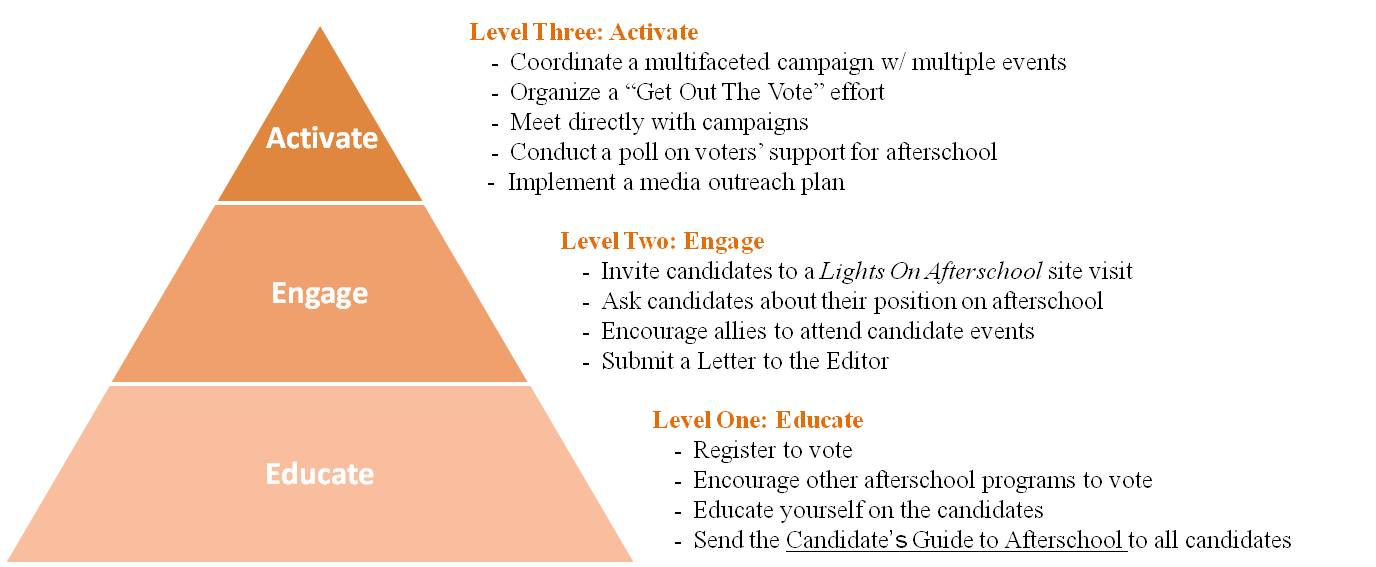
This diagram →
offers suggestions for how you should focus your efforts depending upon the level of involvement you choose.
| Note: This toolkit is filled with an abundance of information on campaigning; however, you shouldn't feel like you have to do it all in order for your efforts to be successful. Rather, you should pick and choose—based on the time you are able to spend and the resources available—the strategies most effective to help you reach your campaign goals.
|
-
Who are potential partners? Some organizations orchestrate campaigns to raise social issues in every election cycle. Find the organizations in your area whose agendas fit well with yours. Chances are they will be working on a broader issue, such as education or children’s welfare, but will welcome the chance to bring you (and your valuable grassroots contacts and supporters) in as a partner. Some examples of organizations to consider: Children’s Leadership Council, Voices for America’s Children affiliates, Every Child Matters and Rock the Vote. Also think about the groups that typically organize candidate debates or forums, such as universities or public television stations. Approaching them early and offering your assistance can help ensure afterschool has a place in the event.
-
What election do you want to target? A statewide campaign requires a significant amount of resources, time and effort. We recommend you start locally andif successful, move to a larger jurisdiction next time. Work with your partners and consider targeting municipal, county or district elections, which will likely be a more effective use of resources. Or, if you determine that state or national offices are most important, target specific aspects of the election, such as securing questions on afterschool in a candidate debate or orchestrating site visits for candidates.
-
What are your campaign goals? You should be able to clearly articulate your goals for the project. This will be especially important when recruiting funders and partners.
-
Show me the money! Identify community trusts, local foundations and other groups that may want to fund an initiative like this. Remember, you are more likely to find funders when you undertake a campaign like this with partners.
-
How will you make the case for afterschool? Downloading the Candidate’s Guide to Afterschool is a good start. The guide can be sent to all candidates as a primer on the importance of afterschool programs as a campaign issue. It is also important to know the political lay of the land in your area. Are statewide or local polling numbers available on afterschool? Do you know where the candidates stand on the issue? If any of them are current office holders, have they sponsored related legislation or signed resolutions? To arm yourself with the afterschool research and messages that will be most effective in your area, see the Facts & Research section of our website.
-
How will you communicate with the public and your supporters? Two basic communication tools are contact lists and a website. At theoutset, you and your partners may want to pool your lists to create a master database. You should continue to build this list throughout the campaign by hosting voter registration, public education and other “list building” events. Your contact list will allow you to call or send out blast emails to your supporters and encourage them to take action. A campaign website will allow you to post event and campaign information, conduct polls and allow the general public to find out more about your issue.
-
What are the “rules of engagement” for nonprofits? There is no fear of—and no danger to—nonprofits participating in a nonpartisan voter and candidate education campaign; the goal is to elevate the issue of afterschool, not a particular candidate or political party.
1616 H St., NW, Suite 820; Washington, DC 20006; Tel.: (202) 347-2030; Fax: (202) 347-2092