The foundation for healthy and positive development is the possession of strong social and emotional skills and competencies that help youth do well academically, maintain positive relationships, be physically and mentally healthy, and become civically engaged.
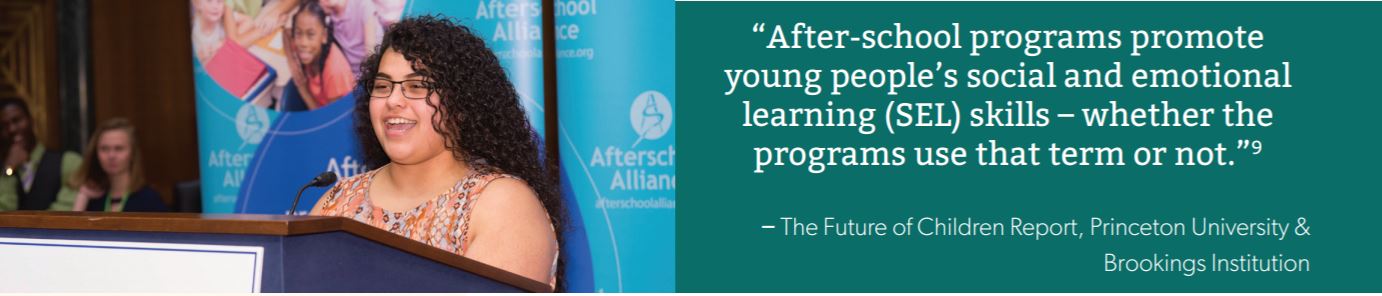
We know that academic learning is inextricably connected to social and emotional development. It’s critical that both in-school and out-of-school educators ensure that youth are developing the social and emotional skills that they need to succeed in school and in life. Evidence shows that youth in high-quality afterschool programs targeting Whole Child outcomes see a wide range of positive effects in the short term, including:

And even more positive effects in the long term:
High quality, Whole Child-focused afterschool programs can have an even larger impact on standardized test scores than programs that have a heavy academic focus. Afterschool and summer programs are key partners in young people’s learning. They help to develop the critical social and emotional skills that help create happier, more engaged, and more productive citizens.
According to a 2016 member survey by the Business Roundtable, a wide array of Whole Child-related skills were both relevant to the vast majority of job openings but also difficult to find in qualified candidates:
Our future economy is dependent upon our ability to provide today’s youth with the opportunity to develop strong social and emotional skills. All youth deserve opportunities to develop social and emotional skills not only in school, but also in afterschool and summer learning programs.
Studies show that young people who participate in Whole Child-focused programs continue to benefit for months and even years afterwards! Young people who participate in these programs have fewer conduct problems, less emotional distress, and lower rates of drug use than their peers.
Studies have found that young people who participate in evidence-based Whole Child programs show an 11 percentile-point gain in academic achievement.
According to a survey by the Riley Institute, “the top 5 skills developed by afterschool are teamwork, communication, problem-solving, self-confidence, and critical thinking.”
A 2015 study found that for every $1 invested in high-quality Whole Child programs, there was a return of $11 in benefits.
High-quality, evidence-based afterschool programs targeting Whole Child outcomes have a wide array of positive effects:
Seeking more talking points about Whole Child in afterschool? Check out "Social and emotional learning: Making the case."
The mission of WINGS for Kids (WINGS) is to provide a safe, supportive environment for at-risk and underserved students, helping them develop the social and emotional skills necessary to succeed in and out of school from a young age. To do this, WINGS creates a culture of social and emotional learning for K-5th graders, employing a comprehensive social and emotional learning curriculum, integrating social and emotional learning into all activities, reinforcing lessons through teachable moments throughout the day, and having both staff and students model social and emotional skills while engaging with one another to help students internalize lessons.
The Possibility Project (TPP) empowers high school youth to tackle issues affecting their lives and take on leadership roles to enact change in their communities through the performing arts and community action. Students create, produce, and perform original theatrical musicals based on their lived experiences while gaining confidence as they learn how to work collaboratively, appreciate diversity, resolve conflicts, set goals, and prioritize responsibilities. The program culminates with community action projects, where students work in teams to select, plan, and manage a project on a social justice issue they want to address in their community

1101 14th St NW Suite 700
Washington, D.C. 20005
(866) KIDS-TODAY | Email us
The Afterschool Alliance is working to ensure that all children have access to affordable, quality afterschool programs. Afterschool programs are critical to children and families today, yet the need for programs is far from being met. Learn more

The Afterschool Alliance has achieved a 4-star rating (the highest ranking) by Charity Navigator for the third consecutive year. Donate now

Support the Afterschool Alliance (CFC# 31020) through your Combined Federal Campaign Workplace Giving Program.